Showing posts with label responsiveness. Show all posts

Monday, 1 August 2011

List of to dos and to remember before the live show!

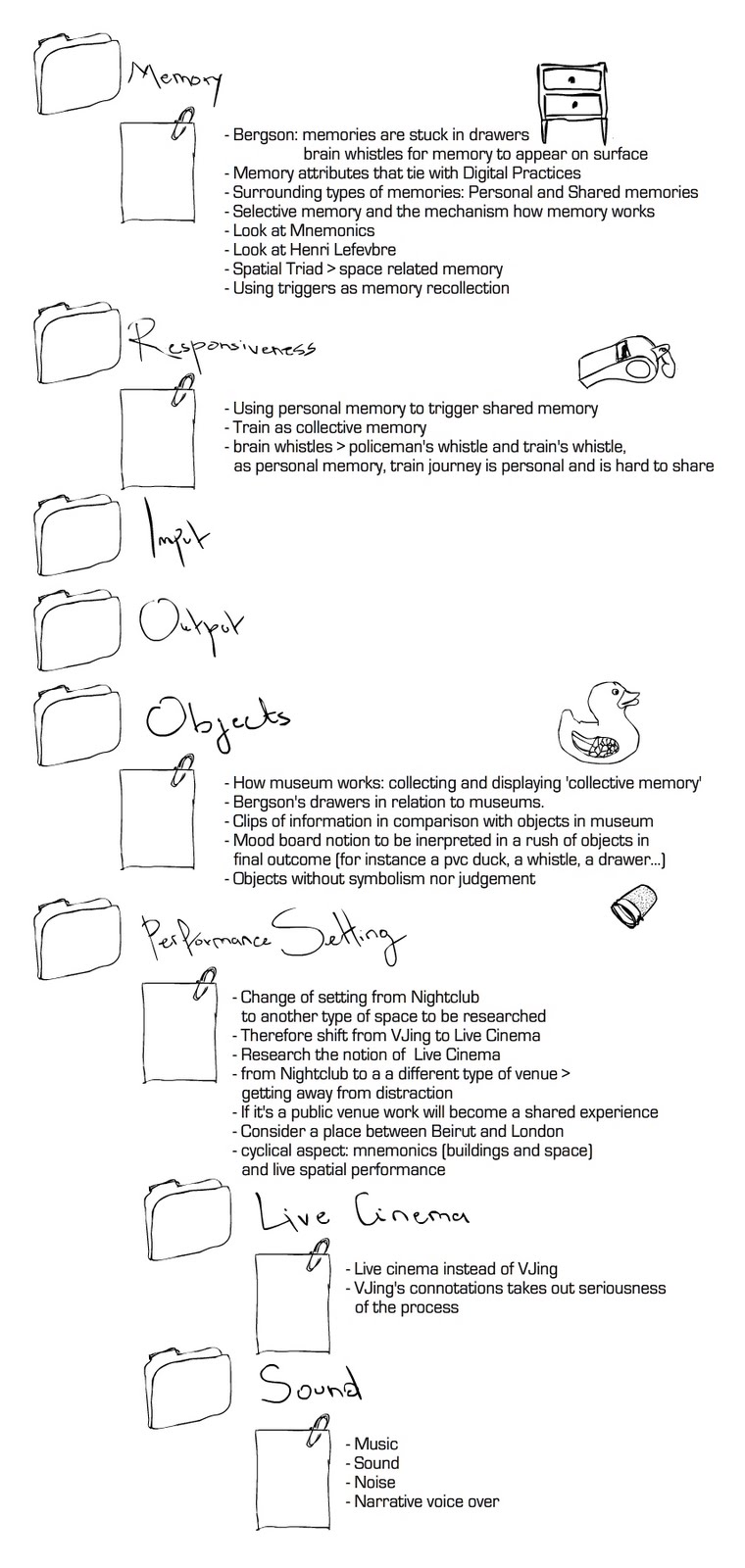
The live already took place last Saturday at Bread, an outdoor café in Beirut. I will be showing documentation soon! but first, I will have to upload the steps, one by one, for archiving purposes. Above is the to do list and the material needed for the live (prepared before the show). I should add on the list a multiple outlet for all the plugs! and a good surface (or screen for the projection) as the grey door was desaturating the colors in the rehearsal, so I had to replace the door with a white wooden board.
I will write in detail about some of the steps listed in the picture above later on.


Configuring Korg to Modul8 – notes to self (for future use)

1- Plug Korg Mini before opening modul8

2-Launch Modul8 and open the project

3-Go to Mapping > Edit Midi Map


4-The different functions will become highlighted in green


5-Click on the function that you want to map on the korg controller, it will create white corners on the function you chose


6-Turn the button (or slider or press button) on korg, the one that you would like it to affect the highlighted function

or
or


7- Go to Mapping > Edit Midi Map to allocate the function to button, end of mapping!


8-If you want to keep the korg buttons and functions the same way all the time, you could go to Mapping > Save Map as Defaults.


9-To give the keyboard functions, same procedure could be applied using the Edit Key Map instead.

Happy Mapping.

Monday, 29 November 2010

rheo: 5 Horizons by Ryoichi Kurokawa

This video audiovisual installation is composed of 5 flat-panel displays and five multi-channel speakers, each panel connected to a mono channel sound, audio is synchronizing the video, while each panel acts independently, together the 5 panels create a sort of an ensemble. I was intending to use this work as an example in my research paper, in the paper that speaks about the fluidity of the New Media Object, then again, It was going to be hard to explain both process and the details and then place this work within the context of the paper. Kurokawa's piece is brilliant and the implementations it suggests, the independent yet self-contained units could be hard to imagine otherwise. check out the video, the quality is much better on the DVD, yet, it is an OK option for now.


Wednesday, 22 September 2010

alphaville festival 2010

Friday 17 September, the alphaville festival running for 2 days debuted, the first day in Whitechapel Gallery and the next day in a venue "Rich Mix". The theme for this year's festival was "visionary cities".

'Our cities are in crisis and their futures depend on architects and urbanists who are willing to look beyond today’s realities to drive the direction for our increasingly urban world. Contemporary city design is full of obstacles standing in the way of visionary thinking. It is time for us to take a position on how we want to live in the future…it is time for a visionary city'. (from the book “Visionary Cities” by The Why Factory, 2009).

I wouldn't be able to describe here all the festival related events, it might come back in a later stage, instead I will be posting some of the enjoyable material.


That was the nicely worked teaser of the festival, it's worth mentioning that this is the 2nd year this festival takes place.

Alpha-ville 2010 Teaser from Alpha Ville on Vimeo.


And the screening program trailer:

Alpha-ville 10 Screening Programme Trailer from Alpha Ville on Vimeo.


Augmented (hyper)reality won in the competition

Wednesday, 11 August 2010

Jonathan Harris and digital artscapes

What interests me in Jonathan Harris's projects is the ability to create stories from different platforms, basing oneself on already existing material out there; out there could be the net, the flood of information that are being uploaded and left on the portals, websites, podcasts...
Being able to archive other people's stories and deciphering them to pure data to be able to manipulate them later on into an interesting form of art seems to be an excellent pathway to the habit the artist has acquired in his early years.

"Jonathan Harris creates digital artscapes out of Eskimo feasts, balloon wishes and the Internet’s feelings"

Tuesday, 22 December 2009

Decode: Digital Design Sensations

The exhibition ‘Decode: Digital Design Sensations’ at V&A explored the themes of Code, Interactivity and Network. But most importantly was the emotional aspect of the works displayed. Looking around what is happening in the Digital Arts field makes you believe in the supremacy of technology and the immensity of art in this context. One cannot start describing, so instead here’s the link!

http://www.vam.ac.uk/exhibitions/future_exhibs/Decode/

This exhibition is a great demonstration of beautiful Digital Arts projects, a complete manifestation of the theory in books.

Friday, 2 October 2009

1W3 Virtual and Actual

In Arcade Fire’s video ‘black mirror’ (directed by Oliver Groulx and Tracey Maurice, director of photography Jean-François Lord) a giant head appears in one of the scenes, in the middle of the water, beautifully composited, a little bit à la Theo Angelopoulos ‘Ulysses’ gaze’ scene of the famous Lenin sculpture being transported in the still river.

Check the Arcade Fire video on: http://www.rorrimkcalb.com/


The giant head in the Arcade fire video is a virtual sculpture while the Lenin sculpture is an actual cement based traditional monument, both appear in a digital format, that of film or video that could be watched on a screen.

It is an example for the introductory question that I have been reading about lately, technology as a tool or a medium? Till what extent can video be considered digital art? Does digital art require the presence of the ‘interactive’, the ‘user’s manipulation of the artwork’? or could it simply be an all set video that has been shot, edited, and finalized, so that the viewer can do nothing but watch it?